FibroScan Results for Fatty Liver: What CAP and Liver Stiffness Mean
A FibroScan report may show two unfamiliar numbers after a visit for fatty liver. One estimates how much fat is in the liver. The other measures how stiff the liver is, which can help clinicians assess the likelihood of scarring. The two numbers answer different questions. Knowing which is which can help you understand what your care team is following and why it may recommend another test or a follow-up visit.
Readers browsing Julissa Clay’s liver health resources can see the product overview for The Non-Alcoholic Fatty Liver Disease Solution. This article draws on clinical guidelines and patient information about liver elastography in metabolic dysfunction-associated steatotic liver disease, often called MASLD and previously known as NAFLD.
Find the liver stiffness result and the CAP result
A FibroScan uses a technique called vibration-controlled transient elastography. The device sends a vibration through the liver and measures how fast the resulting wave travels. The liver stiffness measurement, sometimes shortened to LSM, is reported in kilopascals, or kPa. A stiffer liver can reflect fibrosis, which is the medical term for scar tissue. Other factors can affect stiffness, so a reading is best interpreted with your medical history and other tests.
The controlled attenuation parameter, or CAP, is reported in decibels per meter, written dB/m. It estimates how much the ultrasound signal weakens as it travels through the liver. Clinicians can use that information to assess steatosis, which means fat in the liver. CAP is an estimate. It is particularly helpful to know that a CAP value is neither a percentage of liver fat nor a measure of the amount of scarring.
If you have a copy of the report, locate the units before comparing numbers. A value in dB/m belongs to a different part of the report from a value in kPa. A conventional abdominal ultrasound may use terms such as “increased echogenicity,” while a FibroScan report gives numerical measurements. Ask which finding prompted the appointment and which measurement the clinician wants to follow.
The same distinction helps when a report uses a letter and a number. A clinician may describe a steatosis grade for fat and a fibrosis stage for scarring. If the report includes an estimated grade or stage, ask how confidently the result supports it. An elastography result estimates the chance of clinically important scarring. A liver biopsy lets a pathologist examine a small tissue sample directly. Clinicians reserve it for situations where that information could answer a question the other tests leave open.
Why your clinician considers more than the scan
Clinical guidelines for MASLD often use a stepwise assessment of fibrosis risk. The first step may include a blood-based calculation called FIB-4. It uses age, the liver enzyme results AST and ALT, and the platelet count. Depending on the initial results and the person’s situation, liver elastography can provide more information about the likelihood of advanced scarring. A clinic may also use other tests if the results do not agree or the first scan is difficult to interpret.
Fat and scarring can vary separately. One person might have a report suggesting liver fat with a low likelihood of advanced scarring. Another might have a stiffness result that needs more investigation even though the fat estimate is only one part of the picture. When you discuss the results, ask which finding shapes the follow-up plan and what the other number adds.
A stiffness measurement is also affected by conditions other than scar tissue. Liver inflammation can increase stiffness, and issues such as congestion or a blockage in the bile ducts can affect the reading. A recent meal can influence the result too, which is one reason clinics give preparation instructions. If you were ill, ate during the fasting period the clinic gave you, or could not follow another instruction, let the staff know. They can decide how much that matters and whether a repeat is helpful.
Results sometimes fall between the ranges that provide the clearest reassurance or concern. In that situation it can help to ask, “What could the next test clarify?” Depending on the preceding results, your clinician may want to repeat the measurement, use another type of elastography, or ask a liver specialist to review the findings. Write down which question is still open so you can see whether the next step answers it.
What happens at the appointment
The clinic may ask you to avoid eating for a period before the scan. Follow the preparation instructions from the team performing your test. If they are unclear, call to ask about water, timing, and medicines. If you have diabetes or take medicine that you usually need to take with food, ask how to prepare before changing the way you take it.
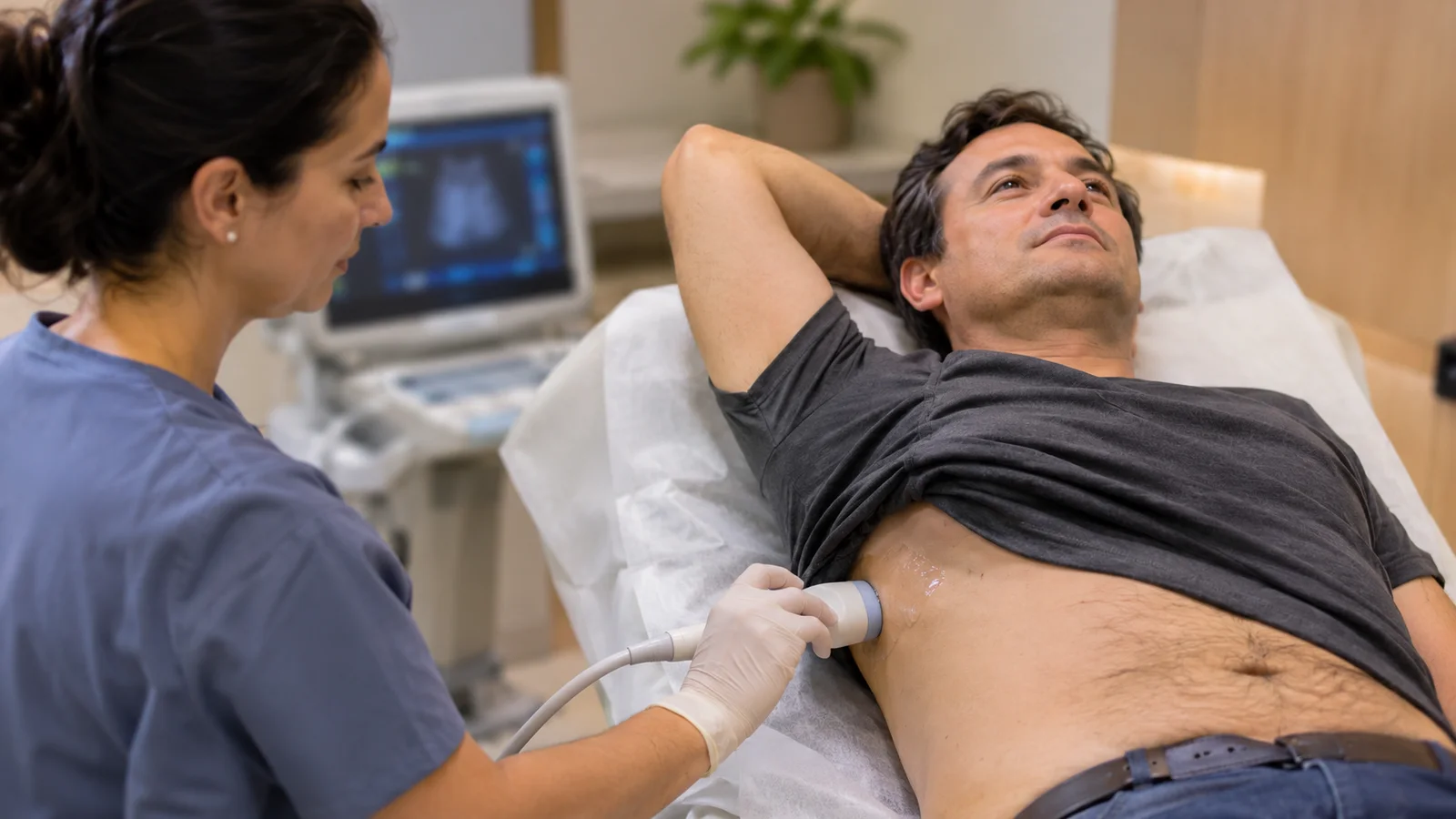
During the scan, you usually lie on your back with your right arm raised if you can do so comfortably. The operator uses gel and places a probe against the skin near the right rib cage. You may feel light tapping as the device takes several measurements. You are generally awake and the scan is done without a needle or a skin incision. Tell the operator if shoulder, rib, or back pain makes it hard to hold the position.
The operator collects several readings so the report can summarize the measurements and indicate how consistent they were. The report may show the middle reading, called the median, and a measure of variation. If the staff had trouble getting reliable readings, ask what that means for your next step. A technically limited result can lead to another attempt or a different test. It does not, on its own, reveal how much scarring is present.
Questions to ask when you get the result
Start with the practical question you need answered: “What does this result tell us about my risk of advanced scarring?” Ask how much confidence your clinician has in the scan and whether the blood tests tell a similar story. The boundaries used to interpret stiffness vary with the clinical setting and the cause of liver disease. A chart made for a different condition or a different kind of elastography can give you the wrong comparison.
Then ask whether follow-up should include a repeat blood test, repeat elastography, or a specialist visit. If the timing depends on your other health conditions or test results, ask what would change it. You can request a copy of the report and keep it with recent results and a list of medicines and supplements. If the test was performed at a separate clinic, ask which member of your care team will discuss it with you.
A FibroScan cannot by itself establish whether there is the kind of inflammation and cell injury that defines metabolic dysfunction-associated steatohepatitis, or MASH. It also does not determine the cause of liver disease by itself. The clinician may consider diabetes, alcohol intake, medicines, and other possible causes. Even when a result looks reassuring, ask whether there are changes or ongoing health needs your team wants to address.
Before you leave, check that you understand how the results will reach you. A report in a patient portal can arrive before the clinician is able to explain it. Find out whether your referring clinician or the team that performed the scan will review it with you. If the report uses terms you do not recognize, note the exact abbreviation and the units. That gives the team a specific question to answer.
Use repeat scans to ask better questions
If you have more than one report, look at the dates and check whether the same type of test was used. Conditions at the time of the scan, including preparation, can matter when comparing readings. Keep the earlier report with the new one if possible. A single number without its units, test method, and reliability details can be hard for the care team to interpret later.
A lower fat estimate and a lower stiffness measurement mean different things. Avoid drawing a conclusion about scar tissue from a change in CAP. If stiffness has changed, ask whether the difference is large enough to be meaningful in your case or whether other findings should be checked first. The most useful comparison may include blood results and clinical information from the same periods.
Readers can also review the book details for The Non-Alcoholic Fatty Liver Disease Solution. For your scan follow-up, bring the report if you have it and ask the clinician to explain the stiffness result, the fat estimate, and what the two measurements mean for the next decision.
Sources and further reading
- Memorial Sloan Kettering Cancer Center, Understanding Your Liver Elastography Results
- EASL, EASD and EASO, Clinical Practice Guidelines on MASLD
- National Institute of Diabetes and Digestive and Kidney Diseases, Diagnosis of NAFLD and NASH
- University Hospital Southampton NHS Foundation Trust, Having a FibroScan
RECOMMENDED READING
A practical guide for readers interested in fatty liver diseaseA guide to fatty liver disease

The Non Alcoholic Fatty Liver Disease Solution
A digital guide by Julissa Clay. Review the guide overview and contents before deciding whether it is relevant to you.
- Topic: fatty liver disease
- Author: Julissa Clay
- Format: digital guide
 Secure checkout through ClickBank
This page contains affiliate links. We may earn a commission if you purchase through them, at no extra cost to you.